top of page
Donate Buddies Year 5.png

Lesson 1
Body Investigators:
Organs vs. Tissues

In this exciting first lesson, students become Body Investigators, exploring the science of helping and the power of human kindness. They learn about altruism — the natural desire to help others — and then dive into the fascinating world of the human body to discover the difference between organs (the body’s “machines”) and tissues (the body’s “materials”).  Through hands-on sorting activities and investigation, students uncover how organ and tissue donation are two different but equally heroic ways to give the Gift of Life. This lesson builds both empathy and scientific literacy, setting the stage for the deeper learning ahead in the Year 5–6 program.

“If you don’t have access to any of the books mentioned, you can substitute any picture book about kindness or sharing.”

Lesson 2
Body Investigators:
The Community Case Files

In Lesson 2, students become Social Investigators, exploring the “who” and “why” behind the donation story. Working in small investigative teams, they study Community Case Files — short profiles of different people such as a parent, a scientist, or a community elder — to uncover each person’s values, perspectives, and questions.  Through guided discussion and empathy-building activities, students learn that everyone’s viewpoint is shaped by what they value most, and that kindness and facts are the best tools for understanding others. By the end of the lesson, they know that empathy — seeing through another person’s eyes — is the key to sharing the Gift of Life message with respect and confidence.

“If you don’t have access to any of the books mentioned, you can substitute any picture book about kindness or sharing.”

Lesson 3
Body Investigators:
The Process Pathway

In Lesson 3, students become Scientific Mappers, exploring how organ and tissue donation actually works through a safe, simplified, and fascinating “Process Pathway.” Working in teams, students use sequencing cards to piece together the steps of two scientific journeys — the Organ Pathway (a fast “machine relay”) and the Tissue Pathway (a careful “material process” involving the amazing Tissue Bank).  Through this activity, students learn that organ and tissue donation is a respectful, organised, and life-changing scientific process. By the end of the lesson, they can clearly explain the key difference between the two pathways:  Organs are urgent — tissues can be stored.

This lesson builds scientific literacy, empathy, and respect for the incredible teamwork behind every life-saving gift.

“If you don’t have access to any of the books mentioned, you can substitute any picture book about kindness or sharing.”

Lesson 4
Body Investigators:
The Case of the Stolen Time

In Lesson 4, students step into the role of Empathy Investigators, solving “The Case of the Stolen Time.” Through the heart-warming real-life story “The Gift of Sight”, they explore how a tissue donation — a cornea transplant — can restore someone’s ability to see and return the Treasure of More Time.  By analysing “the problem,” “the evidence,” and “the solution,” students connect the science of tissue donation to the human stories behind it. They learn that while organ donations can save lives, tissue donations can give back quality of life — allowing people to see, move, and live fully again.  This lesson is a pivotal turning point in the unit, blending empathy, science, and storytelling to help students understand the real meaning of the Gift of Time.

“If you don’t have access to any of the books mentioned, you can substitute any picture book about kindness or sharing.”

Lesson 5
Body Investigators:
The Activation Code

In Lesson 5, students unlock the most powerful clue in the entire donation process — the family conversation. Through an interactive “Top Secret Investigator” challenge, they discover that the family’s yes is the “Activation Code” that sets the whole “Process Pathway” in motion.

Using puzzles, ciphers, and evidence-based reasoning, students learn that sharing your wishes — your Hero’s Echo — is an act of kindness and trust that makes a family’s decision easier during a difficult time.  This lesson transforms an emotional topic into a logical, empowering investigation. By the end, students understand that the key to every life-saving journey is something simple and human:  “Sharing your wish is the key.”

“If you don’t have access to any of the books mentioned, you can substitute any picture book about kindness or sharing.”

Lesson 6
Body Investigators:
The Hero's Treasury

This lesson takes students deep into the heart of donation by exploring the incredible “Treasures of Life” that can be given through the Hero’s Pledge. Using the magical metaphor of the Hero’s Treasury, students discover the difference between life-saving organs (the “Jewels of Life”) and life-transforming tissues (the “Repair Kits”).  Through sorting challenges, treasure cards, and a creative “Treasure Map” activity, students uncover what each treasure does and how it can restore life, sight, movement, and hope. The lesson focuses on empathy and altruism, helping students understand that one Hero’s Treasury can save multiple lives and transform many more.  By exploring the real impact of these gifts, students learn that kindness is powerful — and that the Hero’s Treasury represents the greatest act of giving.

“If you don’t have access to any of the books mentioned, you can substitute any picture book about kindness or sharing.”

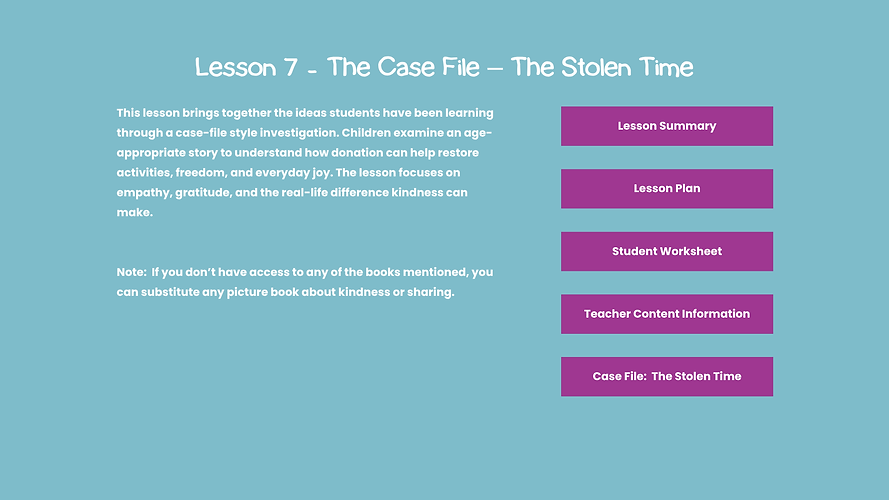
Lesson 7
Body Investigators:
The Case File: The Stolen Time

This lesson brings together everything students have learned so far by introducing their first real-world inspired “Case File.” Acting as Body Investigators, students explore a fictional but age-appropriate story about someone who lost a meaningful activity or freedom because of illness — their “stolen time.” Through active listening and guided investigation, students identify the Problem, the Hero’s Solution, and the Joyful Outcome that follows a life-changing tissue donation.  Using the “Case File Log,” students analyse how the Hero’s Pledge and the Hero’s Treasury can return movement, sight, confidence, or independence. The lesson emphasises empathy, gratitude, and understanding the real human impact of donation in a safe and positive way. By celebrating the restored activity, students discover how kindness can unlock joy and transform lives.

“If you don’t have access to any of the books mentioned, you can substitute any picture book about kindness or sharing.”

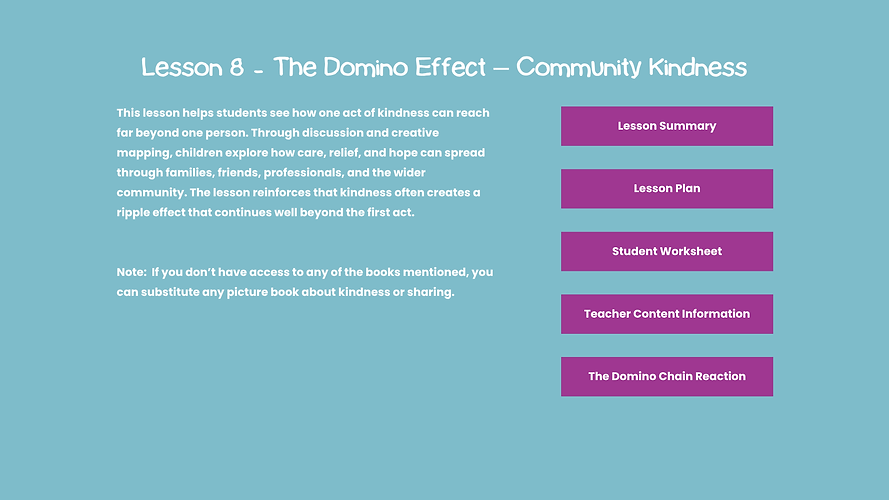
Lesson 8
Body Investigators:
The Domino Effect: Community Kindness

This lesson brings together everything students have learned by exploring how one act of kindness can create a powerful ripple effect. Using the visual metaphor of a domino chain, students discover that the Hero’s Pledge doesn’t just help the recipient — it spreads joy, hope, and relief to families, friends, doctors, and the wider community.  Through discussion and a creative mapping activity, students identify the many people who benefit when someone receives the “Treasure of Time.” By tracing the chain reaction outward from the recipient, students see how a single choice can transform an entire community.  This lesson celebrates altruism, reinforcing that kindness doesn’t end with one person — it continues to fall forward, touching lives in ways we can’t always see.

“If you don’t have access to any of the books mentioned, you can substitute any picture book about kindness or sharing.”

Lesson 9
Body Investigators:
The Hero's Legacy: The Time Capsule

This final lesson brings the entire unit together in a joyful and meaningful celebration. Students look back on all the heroic ideas they’ve explored — from the Activation Code to the Domino Effect — and choose the one message they believe is powerful enough to preserve for the future. Through designing a symbolic artifact and contributing it to the class “Hero’s Legacy Time Capsule,” students express what kindness, altruism, and community mean to them.  The focus is on reflection, creativity, and legacy, giving students a memorable way to honour the Hero’s Echo and the positive impact of sharing their wishes with others. This concluding lesson leaves students with pride, a sense of accomplishment, and a lasting understanding that they can carry kindness forward into their own communities — today, tomorrow, and beyond.

“If you don’t have access to any of the books mentioned, you can substitute any picture book about kindness or sharing.”
bottom of page