top of page
Donate Buddies Year 7.png

Lesson 1
The Alchemist's Code:
Decoding Altruism

This introductory lesson invites students into the world of “Modern Alchemy,” exploring how organ and tissue donation can transform a tragic moment into renewed life for others. Students examine the concept of Altruism—helping others without expecting anything in return—and learn to distinguish between intrinsic and extrinsic motivations through engaging real-life scenarios.
They also investigate the biological “Multiplier Effect,” discovering how one donor can save up to seven lives and improve many more through tissue donation. By the end of the lesson, students understand donation as a powerful act of active citizenship and begin drafting their own “Conversation Code,” reflecting on how values shape the way we communicate important choices with family.

“If you don’t have access to any of the books mentioned, you can substitute any picture book about kindness or sharing.”

Lesson 2
The Alchemist's Lens:
Perspectives & Perception

In this lesson, students step into the role of “Community Alchemists,” learning how different people see the same issue through completely different lenses. Using optical illusions and guided reflection, students explore how family history, culture, beliefs, and personal values shape the way someone interprets information about health topics like donation.  Through the Guild Analysis activity, students examine four key community groups—the Traditionalists, the Guardians, the Facts-First Crew, and the Spiritualists—and decode the values that guide each group’s decisions. Students then practise “transmutation,” rewriting raw facts into respectful, audience-specific messages. This lesson builds empathy, cultural understanding, and communication skill, preparing students for more complex discussions later in the unit.

“If you don’t have access to any of the books mentioned, you can substitute any picture book about kindness or sharing.”

Lesson 3
The Alchemist's Laboratory:
Systems & Innovation

In this lesson, students step into the “Alchemist’s Laboratory” to uncover the high-tech systems that make organ and tissue donation possible. They explore the two major pathways—the urgent Organ Sprint and the banked Tissue Marathon—learning how time, preservation, and logistics shape each journey.  Through hands-on sequencing activities and a deep dive into future innovations such as machine perfusion and 3D bioprinting, students discover how science and technology are working to solve the challenges of time and supply. The lesson finishes by highlighting the most important truth of all: even in a world of jets, databases, and robotics, the entire system still relies on one simple human action—having the conversation.

“If you don’t have access to any of the books mentioned, you can substitute any picture book about kindness or sharing.”

Lesson 4
The Alchemist's Hourglass:
Restoring Time

In this lesson, students explore how donation restores more than biological life — it restores Time. Using the metaphor of the Hourglass, students map their own Future Timelines to understand the value of the years, milestones, and experiences ahead of them. Through Sam’s “Frozen Map” case study, they compare their expanding futures with the limited possibilities faced by a young person waiting for a transplant.  Students then investigate the difference between “being alive” and “truly living,” learning how donation can return school, sport, family life, and long-term dreams. The lesson concludes with a reflective Time Capsule entry, encouraging students to appreciate their own health and recognise how a donor can flip the hourglass and give someone their future back.

“If you don’t have access to any of the books mentioned, you can substitute any picture book about kindness or sharing.”

Lesson 5
The Alchemist's Voice:
The Catalyst of Consent

This lesson introduces students to one of the most important realities of organ and tissue donation: the power of communication. Using the metaphor of an alchemist’s catalyst, students explore how a simple conversation can transform potential into action. Even when someone is registered as a donor, their wishes must be known by the people who love them most — and speaking up becomes an act of kindness.  Through data exploration, discussion, and a creative “Catalyst Script” activity, students learn that sharing their wishes removes pressure and uncertainty from families during difficult moments. The focus is not on medical procedures, but on empathy, communication, and understanding how a single conversation can double the chance of saving a life.  This lesson empowers young people to find their voice, break the “cringe barrier,” and recognise that talking openly with their family is a meaningful way to protect those they care about — and potentially change lives.

“If you don’t have access to any of the books mentioned, you can substitute any picture book about kindness or sharing.”

Lesson 6
The Alchemist's Choice:
The Ethical Pledge

This lesson guides students into one of the most important ethical ideas in the donation world: how choice works. By exploring the differences between Opt-in and Opt-out systems through the relatable metaphors of “The Volunteer” and “The Default,” students learn why Australia values donation as a freely given gift. The lesson encourages critical thinking around autonomy, trust, and informed decision-making without overwhelming students with legal or political complexity.  Through discussion prompts, scenarios, and a focus on the power of a shared decision — the Ethical Pledge — students discover that telling their family their wishes is often more impactful than signing a form. Behavioural science concepts such as Nudge Theory help students recognise how default settings shape human behaviour. The lesson empowers young people to understand the significance of informed choices and the importance of respectful family conversations, all while maintaining a balanced, thoughtful approach.

“If you don’t have access to any of the books mentioned, you can substitute any picture book about kindness or sharing.”

Lesson 7
The Alchemist's Legacy:
Finding Light in Loss

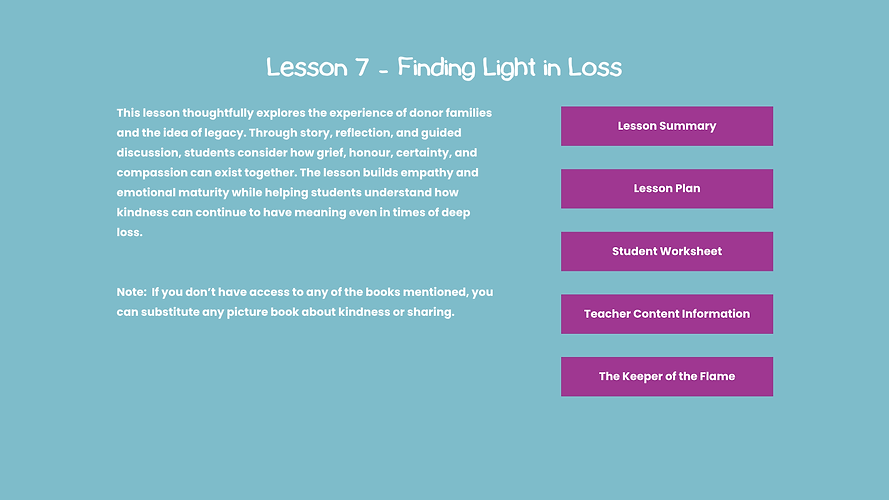
This powerful lesson guides students through one of the most meaningful parts of organ and tissue donation — the experience of the Donor Family. Through the metaphor of The Alchemist, students learn how families can transform deep grief into a legacy that brings life and hope to others.  Using the sensitive teacher-read story “The Keeper of the Flame”, students explore complex emotions with care, compassion, and maturity. They discover that when a loved one’s wishes are known, it can replace uncertainty with pride, helping families find comfort and meaning during an incredibly difficult time.  The lesson reinforces key ideas such as legacy, certainty, and the transformative power of donation — where one final act of kindness can ignite new life for others. Students reflect on how honour, gratitude, and compassion shape the donor family’s journey and deepen the impact of the heroic gift.  This lesson encourages empathy, respect, and emotional intelligence, helping young people understand how kindness can continue even in moments of loss.

“If you don’t have access to any of the books mentioned, you can substitute any picture book about kindness or sharing.”

Lesson 8
The Alchemist's Broadcast:
Spreading the Gold

This creative Year 7 lesson empowers students to become young communicators and campaign designers. Building on everything they have learned about kindness, legacy, and the power of informed choices, students step into the role of “Alchemists” — turning knowledge into positive impact.  Through exploring different “Guilds” (audience groups) and choosing the right tone, imagery, and key facts, students learn how messages spread through communities just like acts of kindness. They discover that the best campaigns don’t rely on shock or pressure — they inspire, uplift, and show people why something matters.  Students design their own kindness broadcast (a poster, flyer, or social media-style message), using symbols of hope such as hearts, shields, hourglasses, and ripples. By focusing on the positive impact of donation — saving lives, restoring futures, and honouring legacy — young people see how their voice can help create a culture where compassion is normal, proud, and powerful.  This lesson blends creativity, empathy, and media literacy, giving students the confidence to communicate big ideas in thoughtful and inspiring ways.

“If you don’t have access to any of the books mentioned, you can substitute any picture book about kindness or sharing.”

Lesson 9
The Alchemist's Vault:
Sealing the Legacy

This powerful final lesson brings together everything students have explored throughout the unit—motivation, empathy, science, time, family conversations, choice, legacy, and the ripple effect of kindness. Using the metaphor of The Alchemist’s Vault (a time capsule), learners reflect on the values, insights, and truths that have shaped their understanding of donation and community impact.  Students create their own symbolic “Philosopher’s Stone,” representing the idea that kindness, empathy, and informed choices can transform lives—turning the “lead” of difficulty into the “gold” of hope. They revisit the full journey of Lessons 1–8 and recognise how each part contributes to a bigger picture of human connection and future possibility.  This lesson concludes with a forward-focused celebration, inviting students to place their personal “Hero’s Pledge” or artifact into a sealed vault. This symbolic act helps anchor their values during a time of rapid growth, reminding them that even as they change, their impact on others can be lasting and profound.  Students leave the unit with a strong sense of identity, agency, and compassion—understanding how small choices made today can shape a kinder, healthier future for their communities.

“If you don’t have access to any of the books mentioned, you can substitute any picture book about kindness or sharing.”
bottom of page